Introduction
Current oncology radiopharmaceutical therapies rely on a single biomarker target to deliver cytotoxic radiation to tumors. However, tumor heterogeneity and receptor variability often limit efficacy of these radiotherapeutics. Dual-biomarker targeting radiopharmaceuticals are the next class of radioligands designed to simultaneously bind to two distinct tumor-associated biomarkers, and is expected to enhance imaging sensitivity and therapeutic efficacy.
This blog explores the dual-biomarker modality for metastatic castration-resistant prostate cancer (mCRPC ).
Why Dual Targeting?
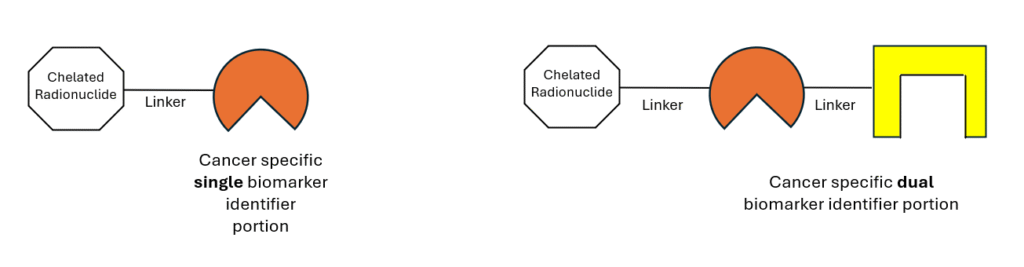
Tumors frequently exhibit heterogeneous expression of biomarkers, and a single-target treatment may miss a portion of cancer cells, leading to incomplete treatment. Dual-targeting agents increase binding to higher number of tumor cells and are therefore expected to also improve tumor-to-background ratio. A diagnostic dual biomarker radioligand (DBRL) can detect tumors that express either biomarker, reducing false negatives in heterogeneous or differentiated lesions, thus would display higher sensitivity compared to single biomarker radioligand (SBRL). A therapeutic DBRL would eliminate tumor cells that express either biomarker, increasing efficacy relative to SBRL.
Figure 1 shows a schematic representation of SBRL and DBRL.
Figure 1: Schematic of a single and dual target theranostic radioligand pair
Proposed dual target radioligand for mCRPC
For prostate cancer, gastrin-releasing peptide receptor (GRPR) is being investigated as a promising imaging target in PSMA-negative prostate cancer. Therefore inclusion of GRPR biomarker to PSMA radioligand would provide a dual-target radioligand. Based on this idea, a schematic of theranostic PSMA-GRPR radioligand for mCRPC is represented in Figure 2:
Figure 2: Proposed dual target Cu-64/Cu-67 theranostic radioligand pair for prostate cancer
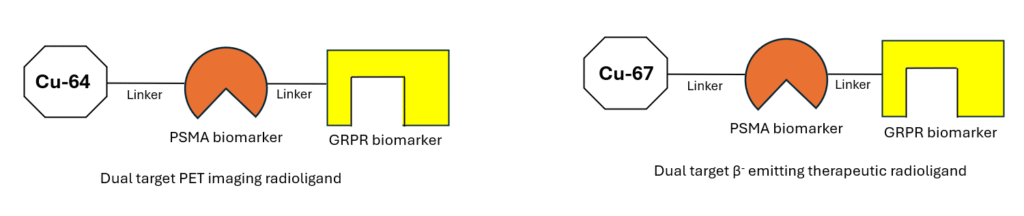
Figure 2 represents a truly theranostic pair for imaging and treatment.
PSMA is a “small molecule” biomarker whereas GRPR is a peptidic biomarker. Therefore the DBRL would be a combination of a small molecule and peptide containing radioligand.
Cu-64 was chosen for PET imaging among Cu-61, Cu-62 and Cu-64 based on the analysis discussed in a previous blog article (ref.)
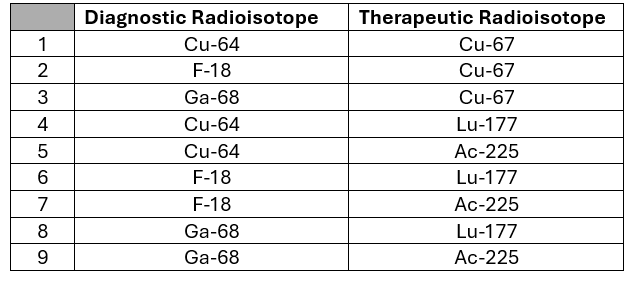
Few possible combinations of theranostic pairs for DBRL are shown in Table 1:
Table 1: Theranostic pairs for dual biomarker radioligand
The therapeutic and diagnostic utility of a radioisotope is largely governed by its average energy and emission yield. These characteristics determine imaging resolution and tissue penetration in theranostic applications. Numerical values for these parameters are listed in Table 2 (Taken from Brookhaven National Laboratory database, ref.)
Table 2: Particle energies and emission yields of radioisotopes from Table 1
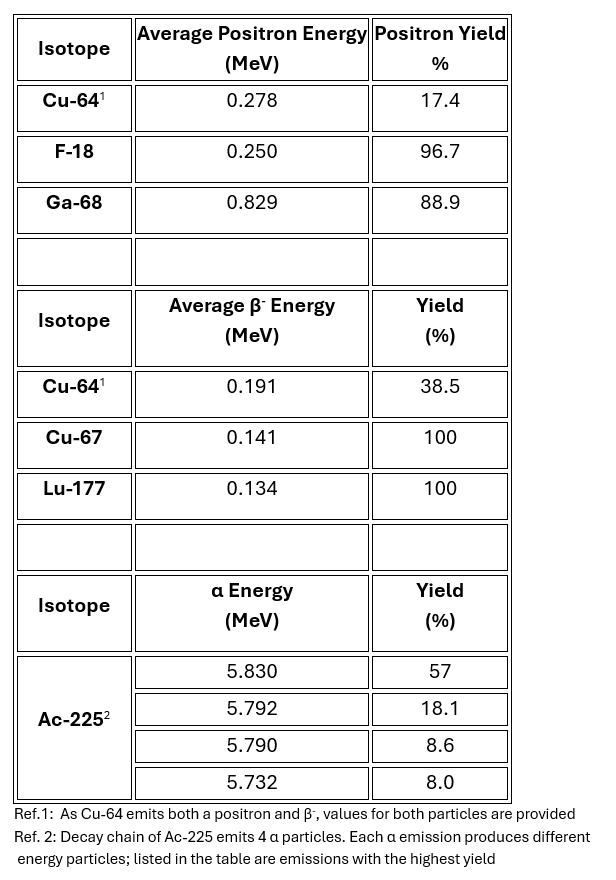
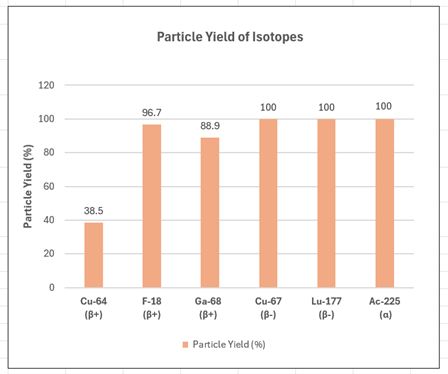
Graphical presentation of particle energies and yield are presented in Chart 1 and Chart 2, respectively.
Chart 1: Average β+, β– and α Particle Energies (MeV) of Radioisotopes From Table 1.
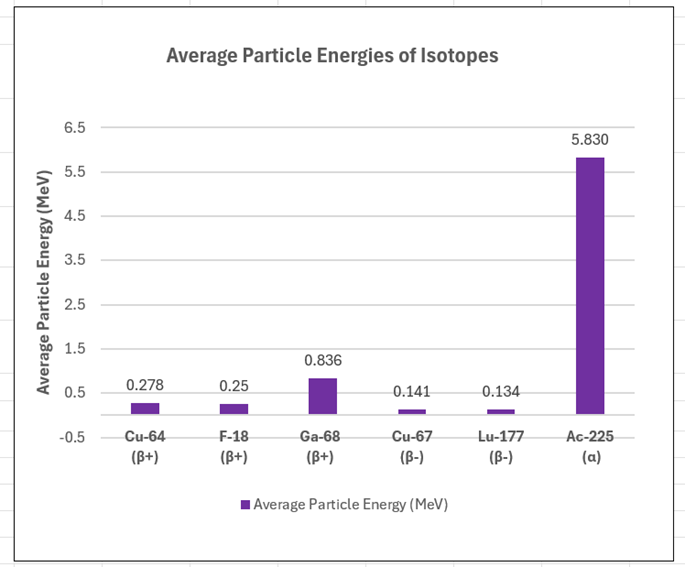
Chart 2: Particle Yield (%) of Isotopes From Table 1
A summary of the parameters of these isotopes is described below with comments on the theranostic use.
Cu-64 emits both β⁺ and β⁻ particles, with an average positron energy of ~0.278 MeV and a positron yield of ~17.4%, enabling PET imaging and potential therapy.
F-18 offers the lowest average positron energy (~0.25 MeV) and highest yield (~96.7%), making it ideal for high-resolution PET imaging.
Ga-68 has a higher average positron energy (~0.836 MeV) and higher yield (~88.9%), allowing faster imaging but with slightly reduced spatial resolution.
Cu-67 emits β⁻ particles with an average energy of ~0.141 MeV, suitable for targeted therapy; it also emits 0.209 MeV gamma hotons and could also be used for SPECT imaging.
Lu-177 emits β⁻ emissions averaging ~0.134 MeV; it also has gamma photons (208 keV) for suitable for SPECT imaging.
Ac-225 is an α emitter with an average alpha energy of ~5.83 MeV, producing high linear energy transfer (LET) for potent cell killing over short ranges.
Dual Target Radioligands from literature
During the literature search for dual biomarker radioligands, we came across FAPI-RGD radioligand, which includes fibroblast activation protein inhibitor (FAPI) biomarker for tumor-associated fibroblasts, and an RGD peptide biomarker expressed in tumor vasculature and angiogenic sites. Early phase preliminary studies were presented for the DOTA-FAPI-RGD radioligand (ref.: “Preliminary Safety, Biodistribution, and Dosimetry of Fibroblast activation protein and Integrin αvβ3 dual targeting radioligand 177Lu-DOTA-FAPI-RGD: First-in-Human Results”, link here). The study was conducted on patients with advanced pancreatic, ovarian, and renal adenocarcinomas. ¹⁷⁷Lu-DOTA-FAPI-RGD was used as a therapeutic agent whereas ⁶⁸Ga-containing ligand was used as a diagnostic agent. Early results showed nearly 90 percent patients experienced tumor shrinkage or disease stabilization.
Final Thoughts
The emergence of dual biomarker radioligands marks an important advancement in precision oncology, offering enhanced tumor detection and treatment through dual-targeting. A Cu-64/Cu-67-based true theranostic radioligand is proposed for mCRPC. Beyond copper isotopes, other radiometal combinations such as Ga-68/Cu-67, Cu-64/Lu-177 could be used. The dual-biomarker radioligand approach broadens the therapeutic window and offers a promising avenue to elevate the standard of care in nuclear medicine.